
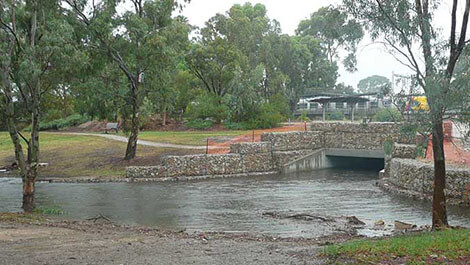
The Board is responsible for the design and construction of the flood mitigation works outlined in the Stormwater Management Plan, including channel upgrades to Brown Hill Creek. This requires an approximate doubling of the flow capacity of the existing creek by widening the channel and/or raising the height of the existing channel walls.
Design Principles
There are various construction approaches that can be taken to achieve the flood mitigation and other outcomes of the project. We work with individual property owners in each location to develop an appropriate design, whether the impacted land is privately owned or public open space. In progressing from the concept designs outlined in the Stormwater Management Plan to the detailed design of the channel upgrades, the following design principles are upheld:
- 1. Minimise earthworks and extent of land disturbed in private property.
- 2. Pursue opportunities for naturalised channel solutions in public open space.
- 3. Minimise tree removals where feasible and avoid or minimise tree impacts for those that are selected to remain.
- 4. Develop channel wall solutions that are easy to construct, with a robust and long asset life and low ongoing maintenance requirements.
- 5. Offer opportunities for high amenity finishes.
Public vs Private Land
Delivery of creek capacity upgrades in public open space provides a unique opportunity to achieve
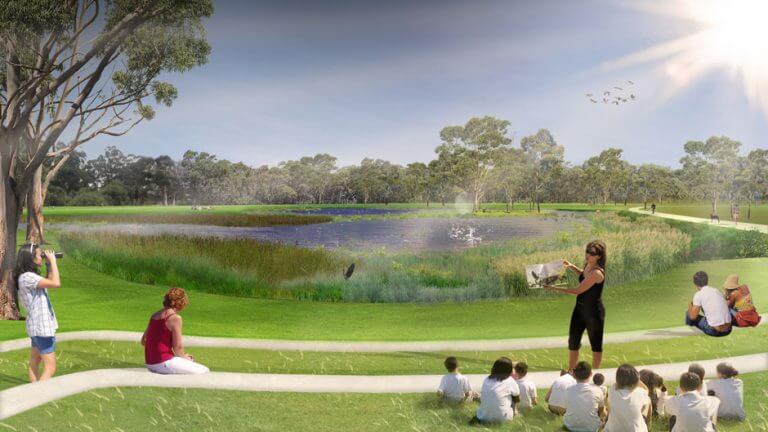
enhanced community and environmental outcomes. The delivery approach seeks to achieve channel naturalisation and biodiversity outcomes with a focus on protection of significant trees, improved water
quality and habitat for native species, and opportunities for increased amenity and community interaction. The watercourse rehabilitation is guided by Ecological Management Plans that focus on protecting local flora and fauna while enhancing biodiversity in the project area. The Ecological Management Plans have a focus on:
- Mitigating sedimentation and bank erosion to maintain quality habitat
- Addressing declared and environmental weeds to prevent competition with native species
- Improving native biodiversity by planting local and indigenous native species
- Enhancing canopy cover by planting new native trees
- Enhancing strata complexity to support diverse fauna by planting a variety of groundcover and understorey flora species that will enhance foraging and nesting opportunities


Some recent examples include the extension of the Wilberforce Walk shared use corridor in Everard Park, the Victoria Park/Pakapakanthi Wetland in the South Park Lands, and the establishment of channel crossings at Wyatt and Packard Street in North Plympton to improve green canopy and pedestrian/cyclist access.
Upper Brown Hill Creek, in particular, is located predominantly within private property, either over back
fences or integrated within the yards of residential properties. In some instances, the creek traverses
beneath dwellings creating a heavily constrained and challenging construction environment. When delivering creek capacity upgrades on privately owned land, the focus is on reinstatement of existing amenity. In the design phase, we work closely with property owners to determine their key objectives, whether that be keeping the corridor as narrow as possible to retain a larger yard area, creating a more naturalised aesthetic, or protecting particular trees and/or structures.

A Design Guide has been developed to establish a palette that reinforces the qualities and characteristics of Brown Hill Creek and is reflective of the project’s aspirations to provide infrastructure that considers aesthetics, resilience, sustainability and is practical to implement and easy to maintain. The Design Guide is intended as a reference manual for use by the implementation team responsible for delivery of the project, and as a style-guide to assist property owners to understand the treatments possible for reinstatement within their properties.
Tree Impacts and Revegetation Strategy
The requirement to widen the existing channel means impacts to trees along the creek corridor are inevitable. In seeking to determine a channel alignment and cross-section that minimises tree removals and impacts, the Board applies the following hierarchy of controls:
- Preservation and protection of Significant and Regulated Trees is given the highest priority.
- Native trees are prioritised over non-native trees.
- Weed exotic trees are removed wherever possible.
This hierarchy of controls is applied within a broader suite of challenges and conflicting interests within the watercourse corridor, such as the protection of existing dwellings and structures, and land ownership. This typically means that:
- There are greater opportunities to minimise tree removals and impacts and achieve naturalised channel outcomes in public open space; and
- Tree removals and impacts for sections of the creek on private property are strongly influenced by the existing development and property owner’s preferences.
The Board is committed to the protection and improvement of the watercourse and riparian
ecosystems and undertakes replacement tree plantings and revegetation of all disturbed land (subject to the property owner’s consent and selections). The Board has developed a list of suitable native species for watercourse and surrounds, informed by Green Adelaide’s planting recommendations and principles for maintaining healthy waterways.
For each project location being delivered, the Board engages an Arborist as part of its delivery team from
the concept design through to the completion of construction. The Arborist assesses all trees that could
potentially be impacted by the channel upgrades and collaborates with the design consultant and property owners to minimise tree removals and impacts. The Arborist is also responsible for overseeing the contractor’s implementation of the Tree Protection Plan for the works.
The Plan
The Stormwater Management Plan is designed to substantially reduce the impact of a significant flood event in the catchment. The full Plan is accessible here.
Project Map

View the project map for an overview of the 4 project stages and find projects affecting you.
Project Stages
Learn more about the 4 stages of project delivery, how these works will protect against flooding, and access up-to-date information about current status.